
Most SEO guides explain terms like a dictionary. Definition. Next term. Definition. Next term.
That is not how anyone learns anything.
So here is a different approach. Every term in this guide comes with a real example from a real website — a food delivery platform, a news site, a furniture manufacturer, or a site you probably visit every week. And for each one I will tell you what changed in 2026 now that Google is using AI to answer searches directly.
By the end you will not just know what these terms mean — you will know exactly why they matter for your site right now.
Check your site right now
See exactly where you rank and which of these issues are affecting your site.
Open resource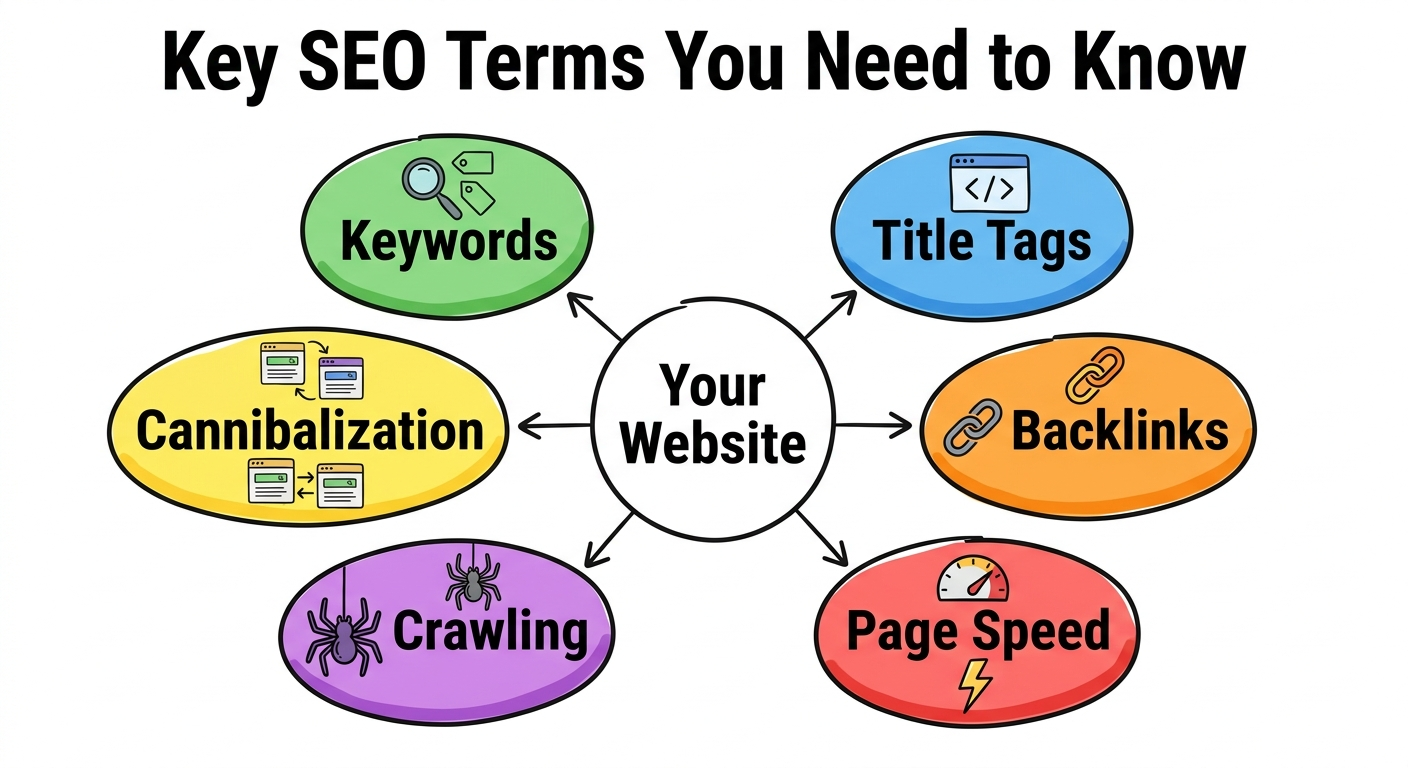
1. Keyword
A keyword is the word or phrase someone types into Google when they are looking for something.
Simple example: when someone in Mumbai types "best pizza near me" into Google — "best pizza near me" is the keyword.
The goal of SEO is to make your website appear when someone searches a keyword that is relevant to what you offer.
When a food delivery platform wants to appear for "food delivery india" — that is their target keyword. When a pizza chain wants to appear for "pizza delivery gurgaon" — that is theirs.
Every page on your site should be targeting one primary keyword. Not five. Not ten. One.
What changed in 2026: Google now answers many informational keywords directly with AI Overviews. If someone searches "what is a keyword in SEO" — Google shows an AI answer at the top and fewer people click through to websites. This makes targeting transactional keywords — "buy", "best", "near me", "how much" — more important than ever.
2. Search Engine Results Page (SERP)
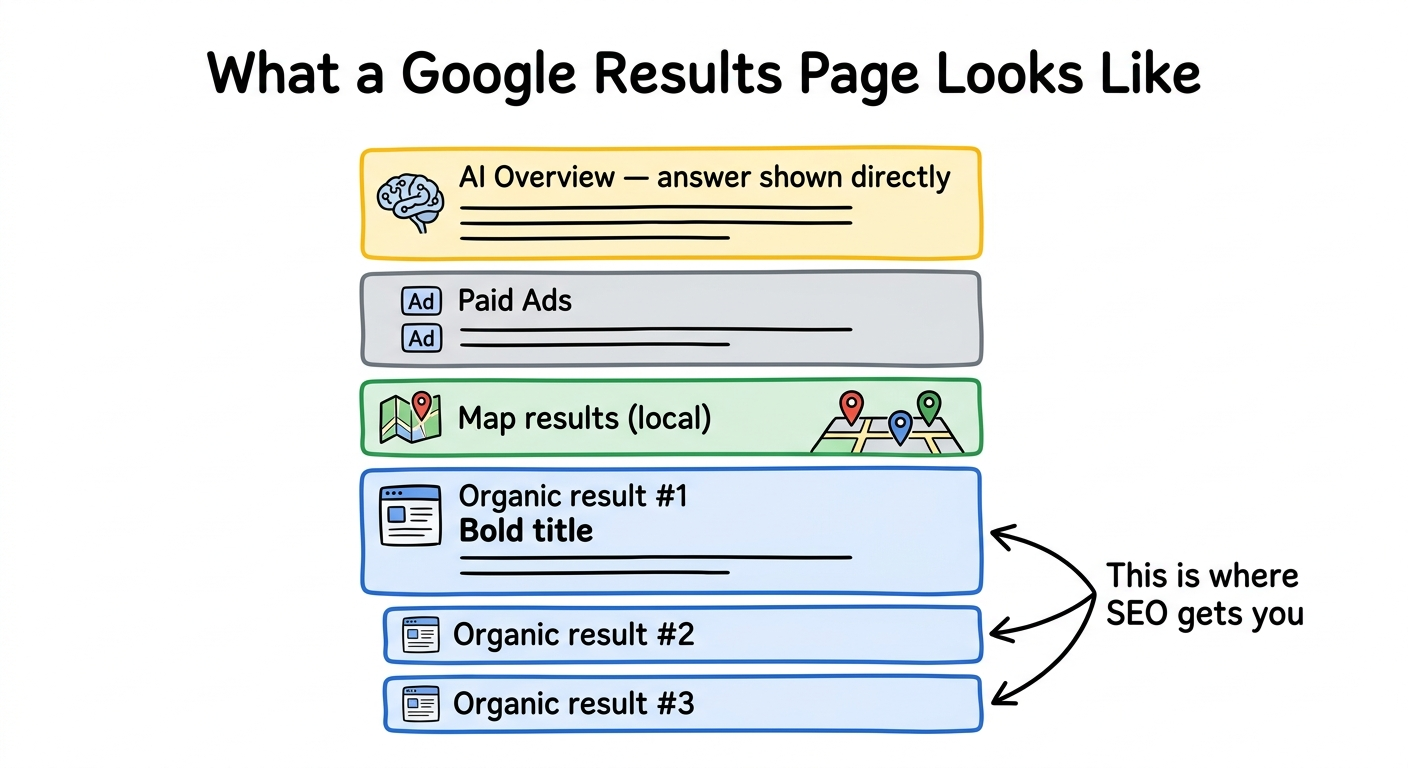
The SERP is the page Google shows you after you search something. It lists websites, ads, maps, images, and now AI answers.
Position 1 on the SERP gets roughly 25-30% of all clicks. Position 10 gets about 2%. Position 11 — page 2 — gets almost nothing.
Real example: search "modular kitchen gurgaon" on Google right now. The SERP shows local map results at the top, then paid ads, then organic results. A modular kitchen manufacturer based in Gurgaon might not be appearing in the top 100 for this keyword despite being exactly what the searcher wants. That is a missed opportunity worth lakhs of rupees every month.
What changed in 2026: the SERP now has more elements than ever — AI Overviews, featured snippets, People Also Ask boxes, image packs, video results. Your organic result might be pushed further down the page even if you rank at position 3.
See your SERP position
Enter any keyword and see exactly where you appear on the results page.
Open resource3. Title Tag
The title tag is the blue clickable headline that appears on the Google results page. It is the first thing someone sees before deciding whether to click your result.
It lives in the HTML of your page:
<title>Modular Kitchen Manufacturer Gurgaon | Your Brand</title>
A good title tag has three things:
- The target keyword near the beginning
- The brand name at the end
- Under 60 characters so it does not
get cut off in search results
Real example: we checked a popular food delivery platform and found their homepage title tag was just their brand name. That is it. For a page targeting "food delivery india" — the keyword was not even in the title. A better title would lead with the keyword and include the brand name at the end. That one change alone could improve their click through rate significantly.
What changed in 2026: Google sometimes rewrites your title tag in search results if it thinks yours is not good enough. A strong title is less likely to be overridden.
4. Meta Description
The meta description is the grey text that appears below the title tag on the SERP. It does not directly affect your ranking but it massively affects whether someone clicks your result.
A good meta description:
- Tells the user exactly what they will
find on the page
- Includes the target keyword naturally
- Has a clear reason to click
- Under 160 characters
Real example: we ran ClimbRK on a furniture manufacturer's website and found 48 out of 50 pages had weak or duplicate meta descriptions. Every single blog post was showing the same generic description about the brand. That tells the searcher nothing specific about the article they are about to click — and costs clicks every single day.
What changed in 2026: with AI Overviews showing at the top of many searches the meta description has become even more important for the results that still get clicks. A compelling description is what separates a click from a scroll past.
Check your meta descriptions
See which pages have weak or missing meta descriptions and get copy paste fixes.
Open resource5. Keyword Cannibalization
This is one of the most common problems on Indian websites and almost nobody knows it is happening to them.
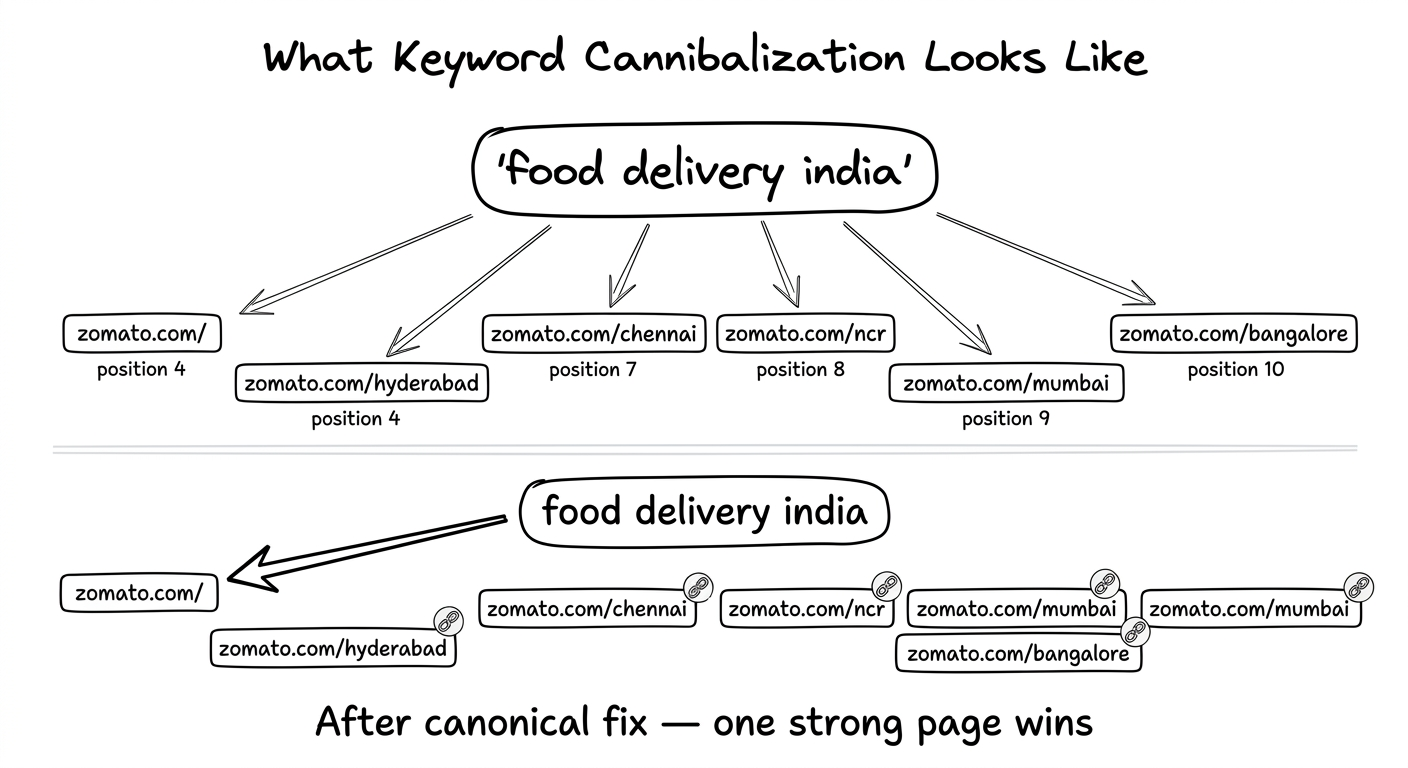
Keyword cannibalization happens when multiple pages on your own website compete for the same keyword. Instead of one strong page owning that keyword — you have two or three weaker pages splitting the ranking strength.
Real example: we ran ClimbRK on a major Indian food delivery platform for the keyword "food delivery india" and found 6 of their own pages showing up on page 1 simultaneously:
Position 4 — main homepage Position 4 — city delivery page 1 Position 7 — city delivery page 2 Position 8 — city delivery page 3 Position 9 — city delivery page 4 Position 10 — city delivery page 5
Now here is an important nuance — large platforms sometimes do this on purpose.
Their city pages are designed to rank locally. "Food delivery mumbai" goes to the Mumbai page. "Food delivery bangalore" goes to the Bangalore page. That is correct SEO strategy for a platform operating across multiple cities.
Large platforms have the domain authority — built over years of traffic, backlinks, and trust — to support multiple pages competing simultaneously. For them it is a deliberate SERP domination strategy. No matter which result a user clicks — they win.
But here is the problem for smaller sites.
Most sites that have this pattern did not plan it. A blogger who wrote three articles about the same topic over two years. An ecommerce store with product pages targeting overlapping keywords. A local business with similar service pages for nearby areas.
These sites do not have the domain authority to support multiple competing pages. Instead of dominating the SERP — they are just splitting their own ranking strength and ranking lower than they should on every page.
The fix is a canonical tag — one line of HTML that tells Google which page is the primary one:
<link rel="canonical" href="https://www.yoursite.com/">
What changed in 2026: Google is getting better at detecting pages with duplicate intent. Sites with unintentional cannibalization problems are being penalised faster than before.
6. Crawling and Indexing
Before Google can rank your page it needs to do two things: crawl it and index it.
Crawling is when Google sends a bot called Googlebot to visit your page and read its content. Think of it as Google's librarian walking through your website and reading every book on the shelf.
Indexing is when Google stores your page in its database and makes it eligible to appear in search results. A page that is not indexed simply does not exist as far as Google is concerned.
Real example: when we launched ClimbRK — climbrk.app — Google had found our pages via the sitemap but had not crawled or indexed any of them. They were showing as "Discovered — currently not indexed" in Google Search Console. For a new site this is normal but it means nobody can find you through search until Google decides to crawl.
The fix: submit your sitemap to Google Search Console and manually request indexing for your most important pages.
What changed in 2026: Google's crawl budget has become more selective. Pages with weak content, slow load times, or poor internal linking get deprioritised for crawling. Technical health matters more now for getting pages crawled quickly.
Check your crawl status
See which pages Google can find and which are being missed.
Open resource7. Domain Authority
Domain authority is a score that predicts how well a website will rank on Google. It is not an official Google metric — it was created by Moz — but it is widely used as a proxy for how much Google trusts a domain.
A brand new website starts with low domain authority. A site that has been publishing quality content and earning backlinks for years has very high domain authority.
Real example: this is exactly why large platforms can get away with multiple pages competing for the same keyword. Their domain authority is high enough that Google trusts all of them. A new site doing the same thing does not have that trust — and pays the price in lower rankings.
This is also why a major news website can publish an article today and have it ranking on page 1 for a competitive keyword within hours. A new blog publishing the same article might take months to appear on page 5. Same content, different domain authority.
What changed in 2026: domain authority matters more for being cited in AI Overviews. Google tends to pull AI answers from high authority sources. Building authority is now about being cited not just ranked.
8. Backlinks
A backlink is when another website links to your website. Google treats backlinks as votes of confidence — the more quality sites that link to you the more Google trusts you.
Not all backlinks are equal. A link from a respected news site is worth far more than a link from a random directory no one reads.
Real example: if a popular SEO blog writes about keyword cannibalization and links to this article on ClimbRK's blog — that is a backlink. It tells Google "this content is worth referencing."
Building backlinks is one of the hardest parts of SEO. The shortcuts — buying links, link exchanges — can get your site penalised. The right way is to create content worth linking to and reach out to relevant sites.
What changed in 2026: Google has gotten better at identifying low quality and artificial backlinks. Quality over quantity matters more than ever.
9. Search Intent
Search intent is the reason behind a search query. What does the person actually want when they type something into Google?
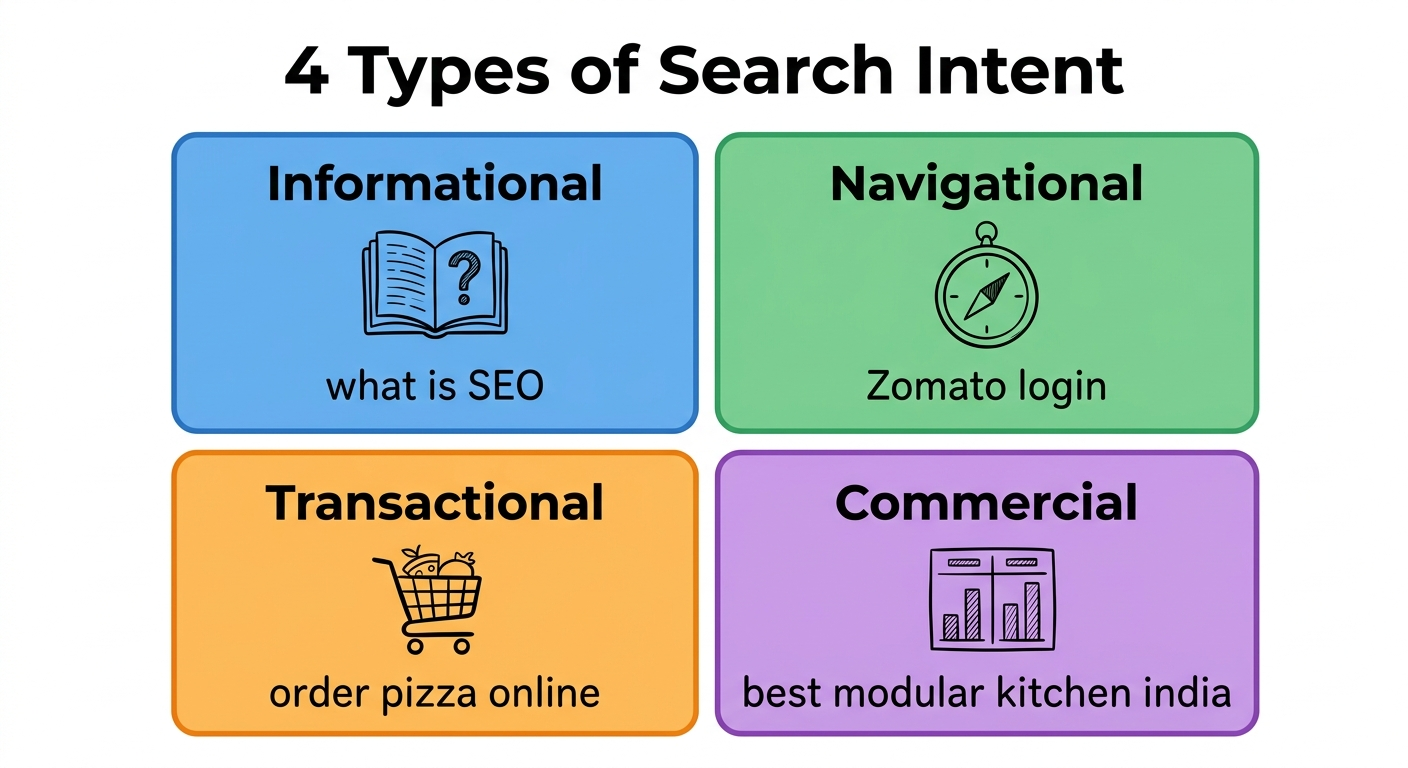
There are four types:
Informational — they want to learn something. "What is keyword cannibalization."
Navigational — they want to find a specific site. "Food delivery app login."
Transactional — they want to buy something. "Order pizza online gurgaon."
Commercial — they are researching before buying. "Best modular kitchen brands india."
Real example: someone searching "modular kitchen cost gurgaon" has commercial intent. They are researching prices before making a decision. A page that only talks about modular kitchen designs without mentioning costs is mismatching the intent — and Google knows it.
Matching your page content to the search intent of your target keyword is one of the highest impact things you can do for rankings.
What changed in 2026: AI Overviews primarily appear for informational queries. Transactional and commercial intent searches still send people to websites. Shifting your content toward commercial intent protects your traffic.
Check your intent match score
ClimbRK scores how well your page matches the search intent of your target keyword.
Open resource10. Page Speed
Page speed is how quickly your website loads. Google uses page speed as a ranking factor — slow pages rank lower and lose visitors before they even see your content.
The benchmark: under 2.5 seconds is good. Over 4 seconds is a problem.
Real example: we ran ClimbRK on a furniture manufacturer's website and found their slowest page loading in 2781 milliseconds — just above the threshold with specific images dragging it down. One fix — adding loading="lazy" to a single image — would bring it under 2 seconds with almost no development effort.
The most common causes of slow pages in India:
- Large uncompressed images
- No CDN
- Too many plugins on WordPress
- Shared hosting that is too slow
What changed in 2026: page speed affects whether Google cites your page in AI Overviews. A slow page signals poor user experience and Google is less likely to reference it.
11. Sitemap
A sitemap is a file that lists all the pages on your website and tells Google where to find them. Think of it as a table of contents for your entire site.
It lives at yoursite.com/sitemap.xml
Without a sitemap Google discovers your pages by following links. This is slow and unreliable. With a sitemap Google knows immediately when you publish a new page.
Real example: ClimbRK's sitemap at climbrk.app/sitemap.xml lists all pages including every blog post. When we published this article Google found it within hours because the sitemap was already submitted to Google Search Console.
What changed in 2026: nothing. Sitemaps work the same way they always have. Submit yours to Google Search Console if you have not already. It takes 5 minutes and makes a real difference for new sites.
12. Visibility Score
A visibility score measures how well optimised your entire website is for search — not just one page or one keyword. It looks at title tags, meta descriptions, heading structure, page speed, content coverage, and more across every page Google can find.
Real example: we ran ClimbRK on several Indian websites and found a wide range of scores:
A college website scored 34 out of 100 A furniture manufacturer scored 78 out of 100 ClimbRK itself scored 91 out of 100
A score of 34 means most pages have missing or weak title tags, no meta descriptions, broken heading structure, and slow load times. Every one of those issues is suppressing rankings for every keyword the site could be ranking for.
The visibility score is your baseline. Fix the issues — re-run — watch the score climb. Rankings follow.
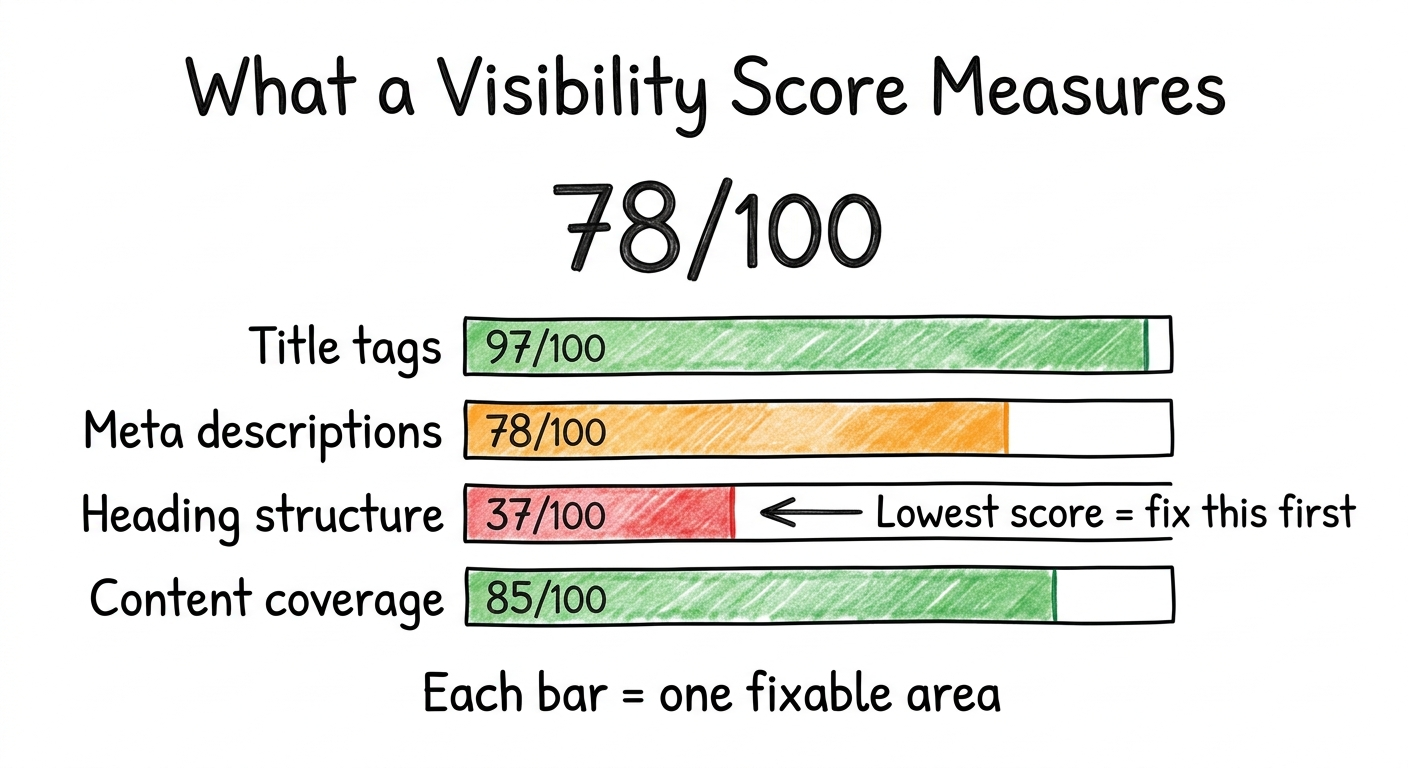
What changed in 2026: with Google using AI to decide which sites to cite in AI Overviews — sites with low visibility scores are being skipped entirely. Technical health is now a prerequisite for AI visibility not just organic ranking.
Check your visibility score
Run a free audit and see your score, your issues, and exactly what to fix.
Open resourceThe one thing these terms have in common
Every SEO term in this guide — keywords, title tags, cannibalization, crawling, backlinks — comes down to one thing: helping Google understand what your page is about and trust that it is worth showing to users.
In 2026 that job got harder because Google is now competing with your pages directly via AI Overviews. But the sites that have done the fundamentals right — clear titles, strong meta descriptions, no cannibalization, fast load times — are the ones being cited in AI answers.
The fundamentals did not change. The stakes just got higher.
Run your free audit
See exactly which of these issues your site has and get copy paste fixes for each one.
Open resource