
SEO in 2026 is not about tricks or hacks. It is about making your page the clearest, most useful answer for a specific search query. Do that consistently and rankings follow.
Most websites fail at the basics — not the advanced stuff. Missing title tags, duplicate meta descriptions, pages Google cannot even find. We ran ClimbRK on hundreds of Indian websites and the same issues appear every time.
This guide covers what actually matters in 2026, what to fix first, and how to track progress week by week.
Run your first rank check
See exactly where your site ranks for your target keywords right now.
Open resourceWhat SEO Means in 2026
SEO is the process of making your page the clearest and most useful answer for a specific search intent.
It is not about keywords stuffed into paragraphs. It is not about getting backlinks from random directories. In 2026 Google is sophisticated enough to understand what your page is actually about — and whether it genuinely helps the person searching.
Strong SEO combines six things working together:
- Intent match — does your page answer what the user actually wants
- Content quality — does it answer deeply and clearly
- Technical health — can it be crawled, indexed, and loaded reliably
- User experience — is it fast and easy to navigate
- Authority — does your domain look trustworthy for this topic
- Consistent tracking — are you measuring what is working
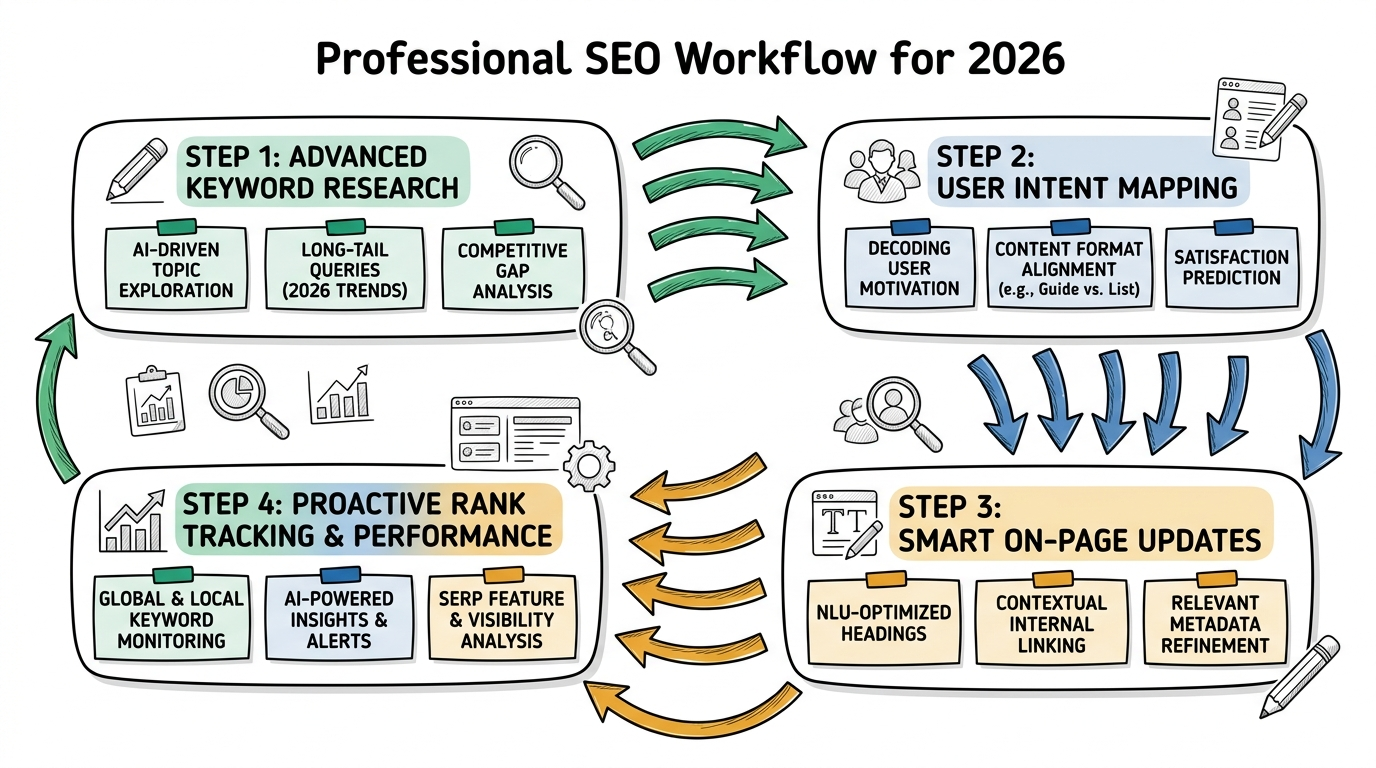
How Search Rankings Work Today
1. Intent match
Does your page match what the user actually wants? A page about "engineering college fees" should answer fees — not just mention the college name.
2. Content quality
Does your page answer deeply and clearly? Shallow pages that cover a topic in 200 words lose to pages that answer every related question.
3. Technical health
Can the page be crawled, indexed, and loaded reliably? No sitemap, broken title tags, and slow load times all hurt rankings regardless of how good your content is.
4. User experience
Is the page fast, readable, and easy to navigate? Google measures how users interact with your page after clicking — if they leave immediately that is a negative signal.
5. Authority
Does your domain look trustworthy for this topic? Authority builds over time through consistent publishing and other sites linking to yours.
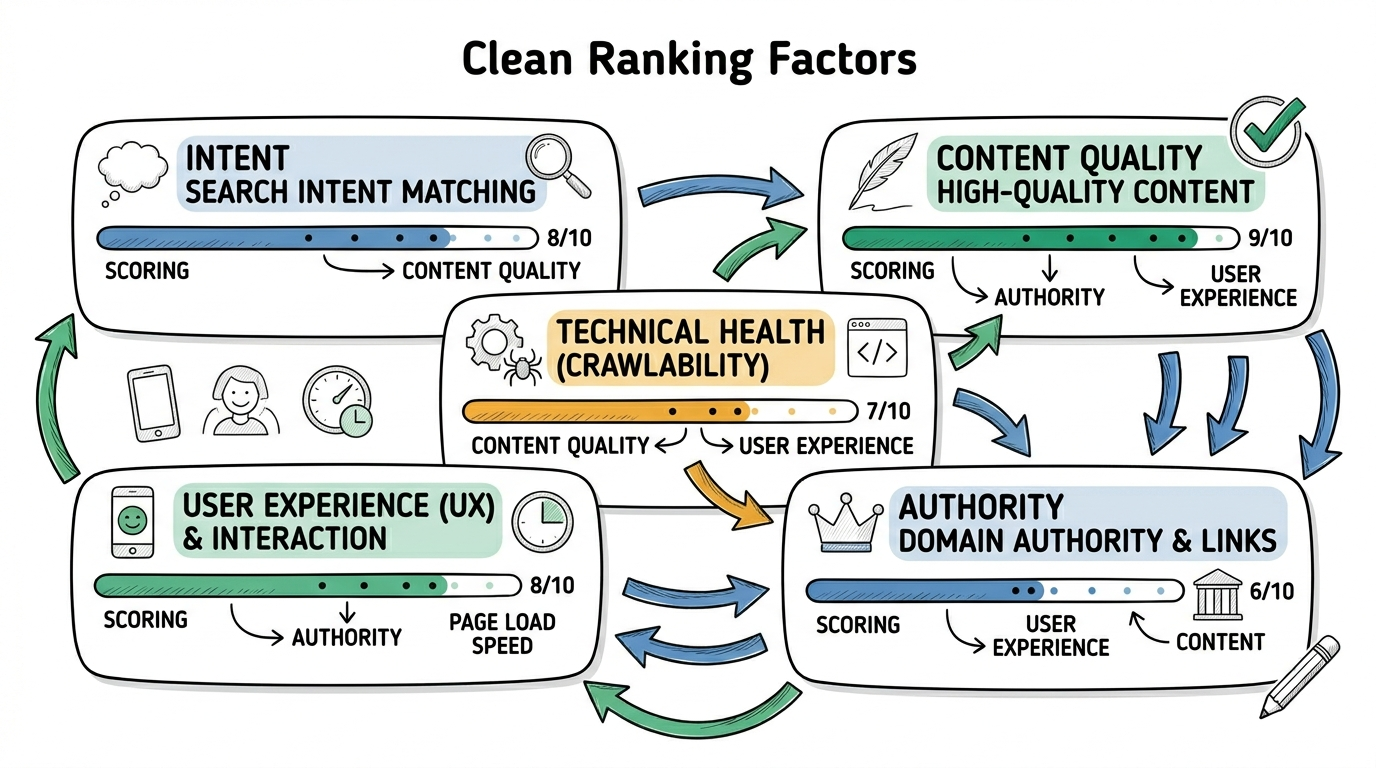
The 6 SEO Basics Every Beginner Must Get Right
1. One keyword theme per page
Each page should target one clear intent. Creating three pages about the same topic splits your ranking strength across all three. This is called keyword cannibalization and it silently hurts rankings without most site owners realizing it.
Check for keyword cannibalization
Find when multiple pages on your site compete for the same keyword and fix it.
Open resource2. Better title tags and meta descriptions
Your title tag is the single most important on-page signal. It tells Google what the page is about and it is what users see in search results before clicking. A weak title loses clicks even when you rank well.
Meta descriptions do not directly affect ranking but they affect click-through rate significantly. A compelling description can double your clicks from the same position.
3. Query-focused headings
Use H2 and H3 headings that match real questions users ask. Not "Our Services" — but "What does this service include and how much does it cost."
4. Internal linking
Link your important pages from other pages on your site. Google discovers and ranks pages partly through internal links. If your most important page has no internal links pointing to it — Google may not know it matters.
5. Technical cleanup
Three technical issues kill more rankings than anything else:
- Missing or broken sitemap — Google cannot find your pages efficiently
- Duplicate title tags — Google does not know which page to rank
- Slow page speed — users leave before the page loads
6. Weekly tracking discipline
SEO is not a one-time fix. Rankings change. Competitors update their pages. The sites that win are the ones tracking weekly and making small consistent improvements.
Weekly SEO Checklist
Run through this every Monday. Takes 20 minutes.
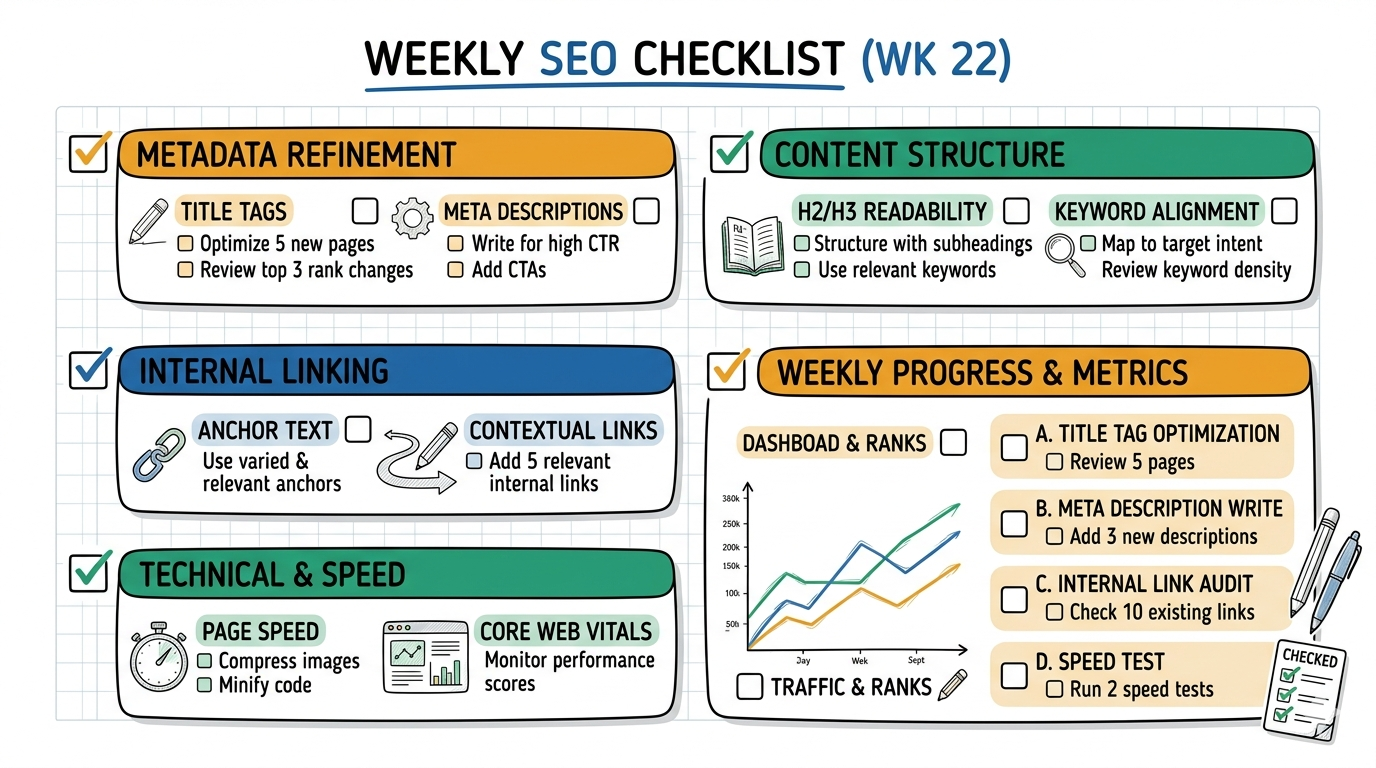
- Review tracked keyword positions — what moved up or down
- Check title tags on your top 5 pages — specific and under 60 characters
- Rewrite one weak meta description — make it specific to that page's intent
- Add one H2 section answering a real user question
- Expand one thin page with more depth and examples
- Add 3 internal links from other pages to your most important page
- Check for any page competing with another for the same keyword
- Log the changes you made and check results next week
Track your keywords weekly in ClimbRK
Check rankings by keyword and country, then focus on pages with the highest upside.
Open resourceSimple 30-Day SEO Plan
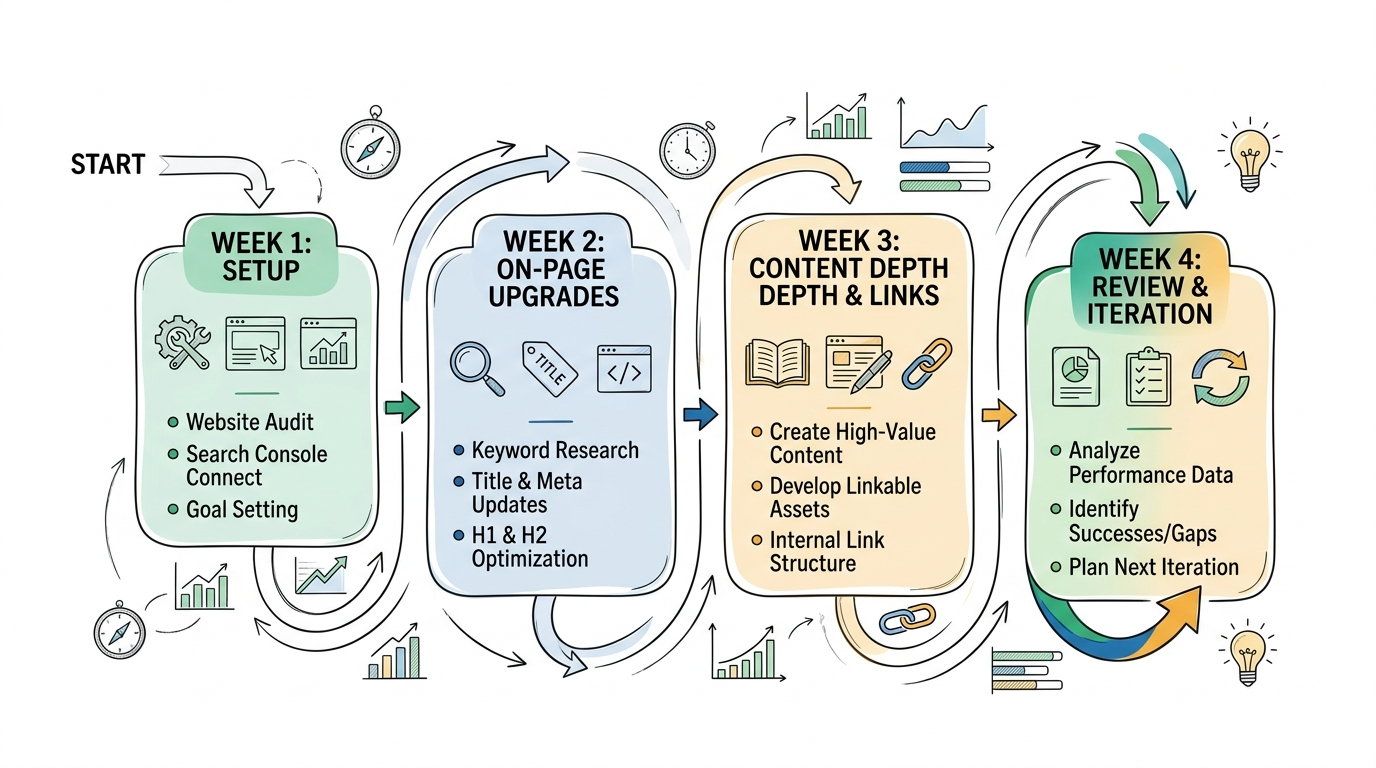
Week 1 — Setup and baseline
Pick 5 to 10 target keywords for your site. Run a rank check on each one and note your current positions. Run a full visibility audit to find the technical issues. This is your baseline — everything from here is measured against it.
Week 2 — On-page fixes
Fix your title tags. Rewrite weak meta descriptions. Add missing H1 tags. Fix any pages without a clear heading structure. These are the fastest wins — changes that can move rankings within 2 to 4 weeks.
Week 3 — Content depth and links
Identify which pages are ranking on page 2 for your target keywords. These are closest to page 1. Add more depth — answer related questions, add examples, include data. Add internal links from other pages pointing to these.
Week 4 — Review and iterate
Re-run your rank checks. Compare to baseline. What moved up — do more of that. What did not move — look at what the top 3 results have that you do not. Repeat the cycle.
Compare ranking movement over time
See what improved, what declined, and where to act next.
Open resourceCommon Beginner Mistakes
Targeting one keyword across multiple pages
Pick one page to rank for each keyword. Consolidate the others with a canonical tag or redirect.
Publishing broad content with weak intent
"Everything about digital marketing" ranks for nothing. "How to write a meta description that improves click rate" ranks for something specific.
Ignoring title and meta quality
These are the first thing users see in search results. A bad title loses clicks from position 3. A good title wins clicks from position 7.
Making too many changes at once
If you change 10 things and rankings improve — you do not know what worked. Change one thing per week and track it.
Not tracking by target country
Rankings are location-specific. A site targeting India should track rankings with India as the country. Results in your browser are personalised and not representative.
What Your Site Actually Scores Right Now
Most website owners have no idea how their site looks to Google. They assume it is fine because it loads and looks good in the browser.
We built ClimbRK to answer that question in 2 minutes. It crawls your site the same way Google does, checks every signal that matters — title tags, meta descriptions, heading structure, page speed, content coverage — and gives you a score out of 100 with copy-paste fixes for every issue.
We have run it on Myntra (73/100), Zomato (73/100), Dominos (86/100), Freshdesk (77/100), and The Hindu (85/100). Every site had fixable issues.
Most Indian websites we have analysed score below 60/100. The fixes are not complex — they just need to be found and acted on.
Run it on your site free. No signup required for the basic check.
Run full visibility analysis
Get prioritised fixes for content, structure, and technical SEO signals — with copy-paste code.
Open resource